

 +86 512 6938 3264

Robots Make Headlines. Components Make Money. Cost Control Decides.
November has been a busy month for the robotics industry.
Earlier this month, Xiaomi revealed that its humanoid robot had completed an eight-hour full-shift operation at a center-console side-panel sorting station in an automotive factory, marking an initial validation of its production-line capabilities.¹
Before that, in October, Tesla announced that its Optimus humanoid robot had entered mass production at its Fremont factory.²
Industry forecasts suggest that China's humanoid robot shipments could reach 100,000 units in 2026.³
But while humanoid robots are making headlines, the real money is flowing somewhere else.
According to media reports, the hardware cost of a humanoid robot breaks down roughly as follows:
45%–65% goes to joint modules.
Nearly 20% of the bill of materials (BOM) is accounted for by lead screws.
While robot manufacturers are still selling the vision, component suppliers making lead screws, reducers and joint assemblies are already receiving orders.³
01 | The Robot Gets the Attention. Its Components Determine the Outcome.
Growth in the upstream supply chain is no longer just a forecast. It is already happening.
According to China's National Bureau of Statistics, output of robot reducers increased by 44.4% year-on-year in the first three quarters of 2026, growing more than 15 percentage points faster than industrial robot production.⁴
In early November, reports also revealed that Schaeffler had secured two new customers in China, generating approximately €400 million in additional orders for its global humanoid robotics business.
The global industrial giant is betting on China's capacity to scale up robot component manufacturing.⁵
What does this mean for machine shops?
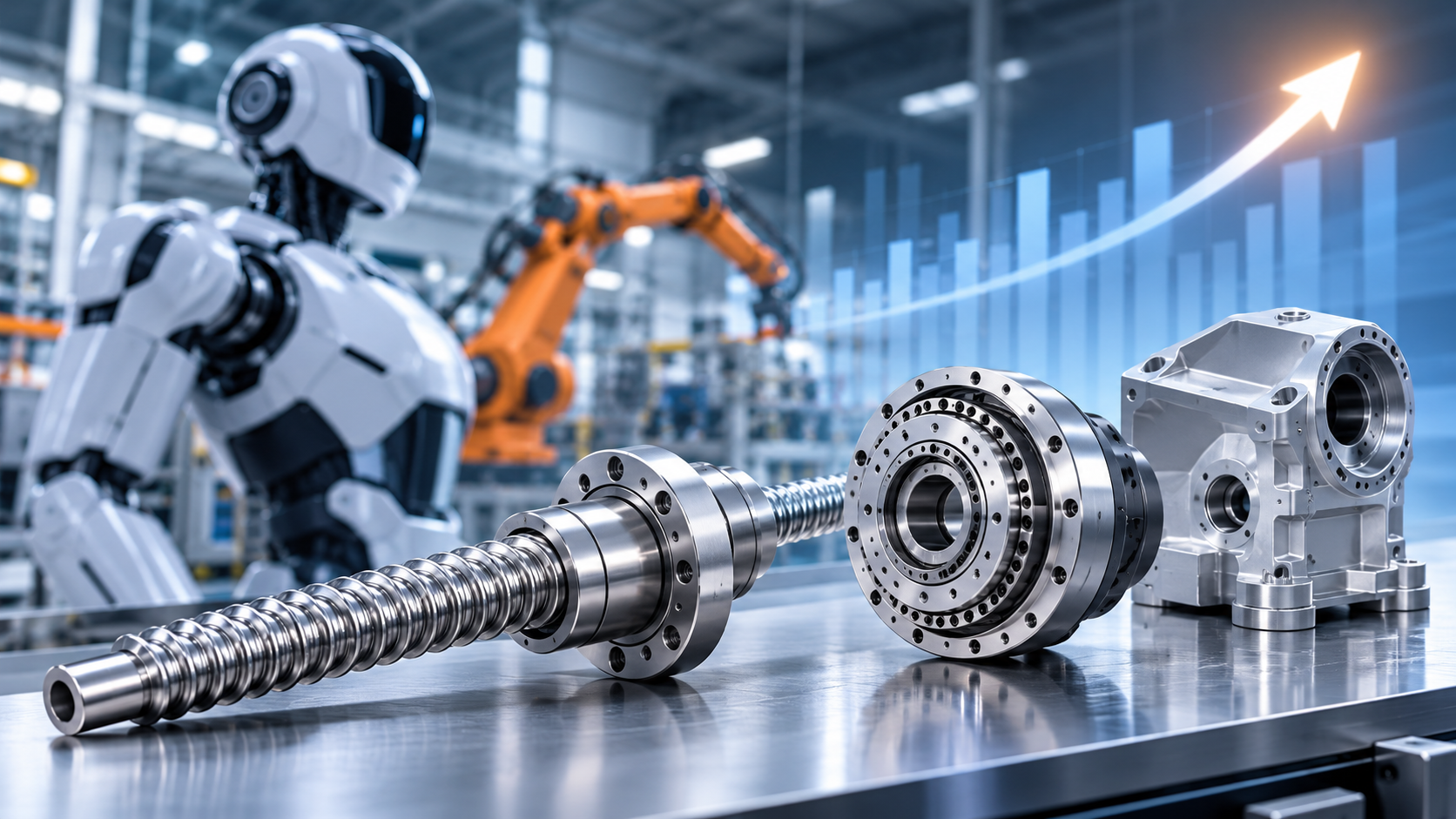
Planetary roller screws, harmonic reducers and joint housings — components that typically demand high precision, thin-wall machining and complex geometries. Turning, milling and grinding are all part of the process.
And then there is the price pressure.
Mass-produced planetary roller screws are now priced as low as RMB 499 per unit.
The average price of harmonic reducers has fallen by nearly 30% in just two years.³
Orders bring opportunities. Prices bring pressure.
The competition is no longer just about whether you can manufacture these components. It is about whether you can manufacture them at scale and still make a profit.
02 | The Tighter the Margins, the More Accurate Your Cost Accounting Must Be.
When unit prices are squeezed down to just a few hundred yuan, profit margins shrink. But the factors eating into those margins don't disappear. In fact, they multiply as production scales up.
Consider what happens on the shop floor:
More tool transactions: Tool pickup and return frequency increases with every shift. Who is tracking the downtime spent searching for tools or waiting for them?
Uncontrolled night shifts: When no one is available to issue tools, operators may grab whatever is at hand. Who pays for using the wrong tool or scrapping a workpiece?
Uncertain tool life: When a tool is returned, has it reached the end of its useful life, or was it discarded prematurely? How much does premature tool replacement cost across the entire inventory?
Inventory imbalance: Frequently used tools are constantly out of stock, while unused tools sit idle in storage. When was the last time anyone calculated the cost of this stagnant inventory?
The purchase price of a cutting tool is only the visible part of the expense.
The hidden costs — time spent searching for tools, rework caused by incorrect tool selection, premature tool disposal and capital tied up in excess inventory — can add up to far more than the tools themselves.
When unit prices are high, healthy margins can hide poor cost accounting.
When prices get squeezed, those hidden costs become impossible to ignore.
03 | What Does Proper Cost Accounting Actually Look Like?
You cannot calculate your true cutting costs simply by reconciling purchase orders at the end of the month.
Every tool pickup and return, every tool's actual service life, and every machining strategy for every component needs to generate traceable data.
This is exactly what Knowhy has been working on.
Smart Tool Box
Control tool circulation.
Track who picks up each tool, which tools remain unreturned, and how used tools are sorted and recycled. Every movement is recorded.
Tool Life Management
Make tool changes data-driven.
Know exactly how much work each tool has performed and whether it is still fit for use. Make tool replacement decisions based on actual usage data, not guesswork.
Process Agent
Choose the right machining strategy.
When a new component comes in, determine the machining operations, process steps and tool selection based on structured process knowledge and data.
Tool Management Operations System
Connect everything into one cost account.
Once the data is standardized and consolidated, you can see exactly which machine, component or production order each tool expense belongs to — all in one system.
When component production ramps up, a busy shop floor is not the problem.
The real problem is finishing a production run without knowing where the money went.
One practical step you can take today:
Pull your tool expenditure records from last month. Don't stop at the purchase orders.
Factor in the downtime spent searching for tools, rework caused by incorrect tool selection, and the cost of idle inventory.
That is much closer to your actual cutting cost.
Understand the numbers first. Then decide how to manage them.
KNOWHY TAKEAWAY
The next time a humanoid robot video floods your feed, don't just count how many steps it takes or how many hours it works.
Think about the lead screws and reducers inside it. Somewhere, those components are being machined on a shop floor.
And think about every component coming off those machines.
Are their manufacturing costs really being accounted for?
Robots make headlines. Components determine the outcome. Cost control decides who wins.
DATA SOURCES
① IT Home | November 3, 2026 | Xiaomi Robots Make a Breakthrough on Two Fronts: Successfully Completing an 8-Hour Factory Shift and Long-Distance Household Tasks (Based on Xiaomi's official announcement).
② Cnfol | October 27, 2026 | Reports on Tesla Optimus entering mass production.
③ EqualOcean | November 12, 2026 | The Money Is All Going to the Supply Chain! (Media-reported figures).
④ National Bureau of Statistics of China | October 20, 2026 | Wang Xin: Industrial Economy Remains Stable with Steady Progress in High-Quality Development.
⑤ NetEase Finance | November 7, 2026 | Reports on Schaeffler's additional humanoid robotics business orders.