

 +86 512 6938 3264

Knowhy Insight | Machine Condition Management
Routine machine inspections often leave behind a series of individual records: What was the machine's condition this time? Were any abnormalities detected?
But a single inspection only tells us about the machine's condition at that particular moment.
Wear, deformation, and other condition changes in critical components such as spindles and ball screws rarely happen overnight. They may not cause an immediate machine shutdown, but can gradually affect machining quality and production efficiency. ①
If inspection results remain isolated records without continuous comparison, it becomes difficult for shop-floor teams to determine whether these changes are persistent or use them as a basis for planning maintenance.
This is exactly where predictive maintenance matters: the gap between a machine still running in production and its condition already beginning to deviate from normal.
01 | Beyond Experience and Alarms: Why We Need Objective Condition Data
In most workshops, machine condition assessments rely on two main sources of information.
The first is the experience of seasoned technicians: listening to machine sounds, feeling temperature changes, and checking the machine's appearance.
The second is alarm information already generated by the CNC system.
However, changes in the condition of critical components are not simply an instant switch between "normal" and "failure."
A 2026 review published in Manufacturing Technology & Machine Tool points out that the operating conditions of critical components such as spindles, cutting tools, and ball screws directly affect machining quality and efficiency. Deformation, abnormal vibration, and wear are among the key factors that can indicate abnormal component conditions. ①
The same review also highlights the limitations of traditional assessment methods based on touch, hearing, and visual inspection, including subjective judgment and difficulties in quantitative evaluation. ①
This does not mean shop-floor experience is any less valuable. It means that experience needs objective condition data for comparison and verification.
Has this machine's condition changed compared with its previous state?
Is the change persistent?
Can maintenance planning be based on more reliable evidence?
● ● ●
02 | Predictive Maintenance: The Challenge Is Making Inspection Practical on the Shop Floor
Minimize disruption to production
First, condition inspection should not require prolonged production downtime. If every assessment requires the machine to stop, undergo modifications, or have additional wiring installed, inspection itself competes with production time. It also becomes difficult to make it part of daily shop-floor operations.
Build continuous condition trends
Second, a single inspection result is not enough.
Industry materials published by the China Machine Tool & Tool Builders' Association indicate that as equipment wears and ages, signals from multiple sources may show continuous patterns of change. ②
A single reading tells us how the machine is doing right now. Continuous comparison helps reveal where its condition is heading.
Support maintenance decisions
Finally, data must serve maintenance decisions.
Collecting condition data and generating another chart are not the end goals. What matters is turning trends established through successive inspections into useful evidence for equipment engineers when planning inspections and maintenance.
These three requirements determine whether predictive maintenance remains just a concept or becomes a practical part of everyday production.
● ● ●
03 | SCB: Inspect Between Tool Changes and Turn Machine Conditions into Trends
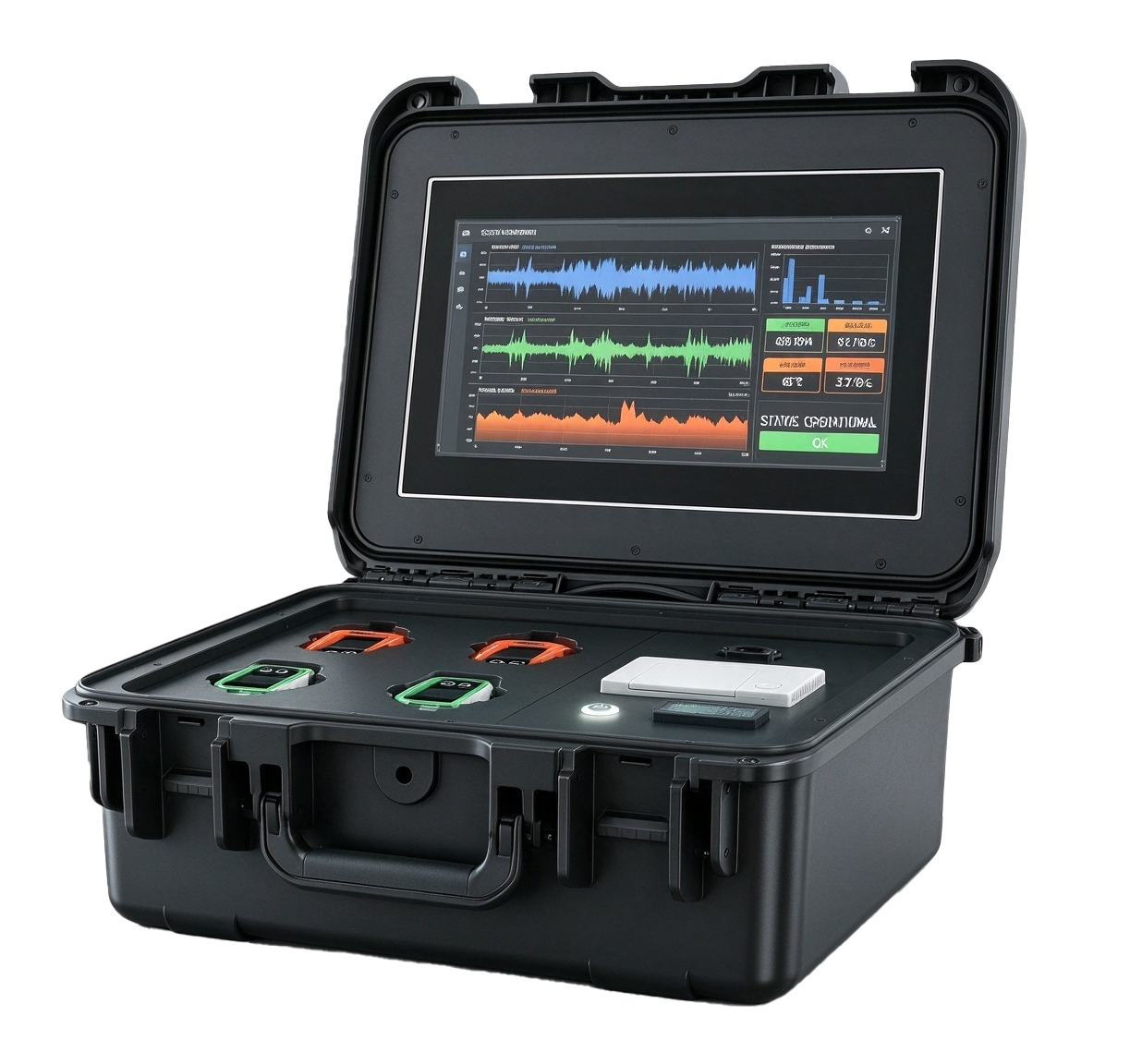
Knowhy SCB Machine Monitoring Device
Knowhy SCB offers an approach designed around the actual production rhythm of machining shops:
No machine modifications or additional wiring required. Quick inspections can be carried out during tool-change intervals, turning machine condition data into visualized trends.
It brings machine condition monitoring into practical shop-floor operations.
Application scenarios
During routine inspections, successive results can be compared to identify whether a machine's condition has changed and whether the change is persistent. This extends inspection beyond a one-time assessment to continuous condition tracking.
When planning maintenance, equipment engineers can look beyond equipment age and actual failure records. Historical condition trends provide an additional reference to support maintenance decisions. ③
This does not replace the experience of seasoned technicians with data. Instead, it gives them another source of machine condition information that can be compared and tracked over time.
From individual inspections to continuous condition trends, and from trends to maintenance decisions, predictive maintenance can finally become part of everyday shop-floor operations.
In our next article, we will take a closer look at how an SCB quick inspection is performed, how successive inspection results build condition trends, and how to interpret those trends.
Key Takeaway
Predictive maintenance isn't about waiting for a smarter alarm.
It's about making changes in machine condition visible through successive inspections.
References
① Li Song, Meng Boyang, Xiang Fuxing et al., A Review of Intelligent Condition Monitoring Methods for Key Machine Tool Components, Manufacturing Technology & Machine Tool, Issue 4, 2026.
Original paper:
https://1951.mtmt.com.cn/cn/article/pdf/preview/10.19287/j.mtmt.1005-2402.2026.04.002.pdf
② China Machine Tool & Tool Builders' Association, World Manufacturing Technology & Equipment Market, Issue 5, 2023. Related materials on predictive maintenance.
Original source:
https://www.cmtba.org.cn/upload/ewebeditor/attach/20231103115223.pdf