

 +86 512 6938 3264

At a State Council Information Office press conference last week, China's industrial performance report for the first three quarters of 2026 delivered some solid numbers: industrial value added by enterprises above the designated size grew 5.3% year on year, while high-tech manufacturing grew 14.3%. ①
But for those of us who work closely with manufacturing shop floors every day, one less conventional statement deserves particular attention:
State Council Information Office Press Conference · China's Industrial Performance Report
More than 100 industrial AI agents, built on the accumulated expertise of seasoned technicians, are being selected for wider application and promotion. ①
The fact that "seasoned technicians' expertise" has made its way into the language of a national-level press conference is significant in itself.
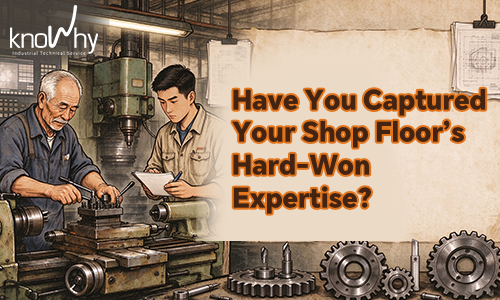
01 | A Factory's Most Valuable Asset Was Once Its Easiest to Lose
Every machining shop has a seasoned technician like this:
They can tell whether a cutting tool is dull just by listening to the machine. A glance at the chips tells them whether the cutting parameters are right. When a machine starts behaving unusually, a quick inspection is often enough for them to identify the problem.
This accumulated expertise is one of a factory's most valuable assets. Yet it has one critical weakness: it exists only in people's heads.
When an experienced technician takes a vacation, that expertise goes on vacation too.
When they retire, their knowledge may leave with them.
Training a new apprentice can take three to five years, and even then, there is no guarantee that the same level of expertise will be passed on.
A factory may spend twenty years building up this knowledge, only to lose much of it when key employees leave.
● ● ●
02 | From "Learning from the Master" to Embedding Expertise in Systems
The traditional approach: Knowledge is passed down through personal instruction and hands-on experience.
↓
The new approach: Expertise is structured, captured, and retained as an enterprise asset.
By placing seasoned technicians' expertise alongside industrial AI agents, the recent press conference sent a clear message: knowledge no longer has to be passed down solely through word of mouth. It can be structured, captured, and scaled—becoming an asset that belongs to the factory itself. ①
The timing is no coincidence. AI adoption among manufacturing enterprises above the designated size has already exceeded 30%. ②
As AI enters the shop floor, what is missing is not necessarily a smarter algorithm. It is the knowledge unique to each factory: how to select the right tools, when to change them, how to determine cutting parameters, and how to handle abnormal conditions.
Without turning this expertise into structured data, even the most powerful AI remains an outsider—one that does not truly understand your shop floor.
● ● ●
03 | How Can a Technician's Expertise Be Captured in an AI Model?
So, how does this work in practice?
Take Knowhy Process Agent as an example. It offers a clear path for turning manufacturing expertise into structured, reusable knowledge:
1. Upload the drawing
AI automatically identifies and analyzes the drawing's geometric features.
2. Review and confirm the drawing
Each feature is checked and verified by an experienced technician. AI does not simply guess when something is unclear.
3. Develop the process plan
Operations and machining steps are automatically broken down, with machine tools, cutting tools, and parameters clearly defined.
4. Select tools intelligently
The system checks available tool inventory and generates a tool preparation list with one click.
In the past, an experienced technician might have needed three days to prepare an initial process plan. Now, a first version can be generated within minutes.
This is not about simply purchasing a generic AI model. It is about using your own engineering drawings to build and continuously improve a model tailored to your factory.
Every confirmation and correction made by an experienced technician can feed back into the model as training data. Each time the technician applies their expertise, the model has an opportunity to learn.
Drawings, models, and data remain within the factory. The expertise is no longer just held by individuals—it becomes an asset the enterprise owns and can continue to build upon.
It doesn't retire. It gets better with use.
And capturing expertise does not necessarily require a major upfront investment.
One practical step you can take today is to make a list:
Which tasks in your shop floor can only be handled because one particular person knows how to do them?
That list is the starting point for identifying the knowledge assets your factory should prioritize capturing.
Knowhy Insight
In the past, passing on expertise depended on people. Today, it depends on how well that knowledge is captured and retained.
Seasoned technicians may retire. Their expertise shouldn't have to.
Data Sources
① State Council Information Office press conference on China's industrial performance for the first three quarters of 2026, October 20, 2026. Figures on industrial value added growth (+5.3%), high-tech manufacturing growth (+14.3%), and the selection and promotion of more than 100 industrial AI agents built on seasoned technicians' expertise. Reported by Xinhua News Agency and the official website of the Digital China Summit, October 21, 2026.
② AI adoption rate among manufacturing enterprises above the designated size exceeding 30%, according to the same press conference on October 20, 2026.