

 +86 512 6938 3264
The Most Expensive Battle of September
The smartphone industry is about to enter one of its most expensive battles of the year.
On September 7, Huawei is set to unveil the Mate XT2.¹
In the early hours of September 10 Beijing time, Apple’s fall event will take center stage—with John Ternus making his debut as CEO, and the long-rumored first foldable iPhone potentially making an appearance.²
Xiaomi’s 18 Fold is also expected to join the race this month.³
Three high-end foldables are set to collide head-on.
Consumers will be watching the price tags.
We want to take you to a different battlefield:
The real winner won’t be decided on stage.
It will be decided on the shop floor—with every cutting edge.
01
The More Expensive the Phone, the Harder the Cut
Why are foldable phones so expensive?
It’s not just the display.
It’s the structure.
According to supply-chain sources, Apple’s first foldable iPhone is expected to have an annual production target of around 10 million units.⁴
That is no small number.
For the precision machining industry, it is an extreme test.
And one of the components putting every cutting tool to the test is the titanium alloy mid-frame—one of the major hardware additions that distinguish foldables from conventional smartphones.⁵
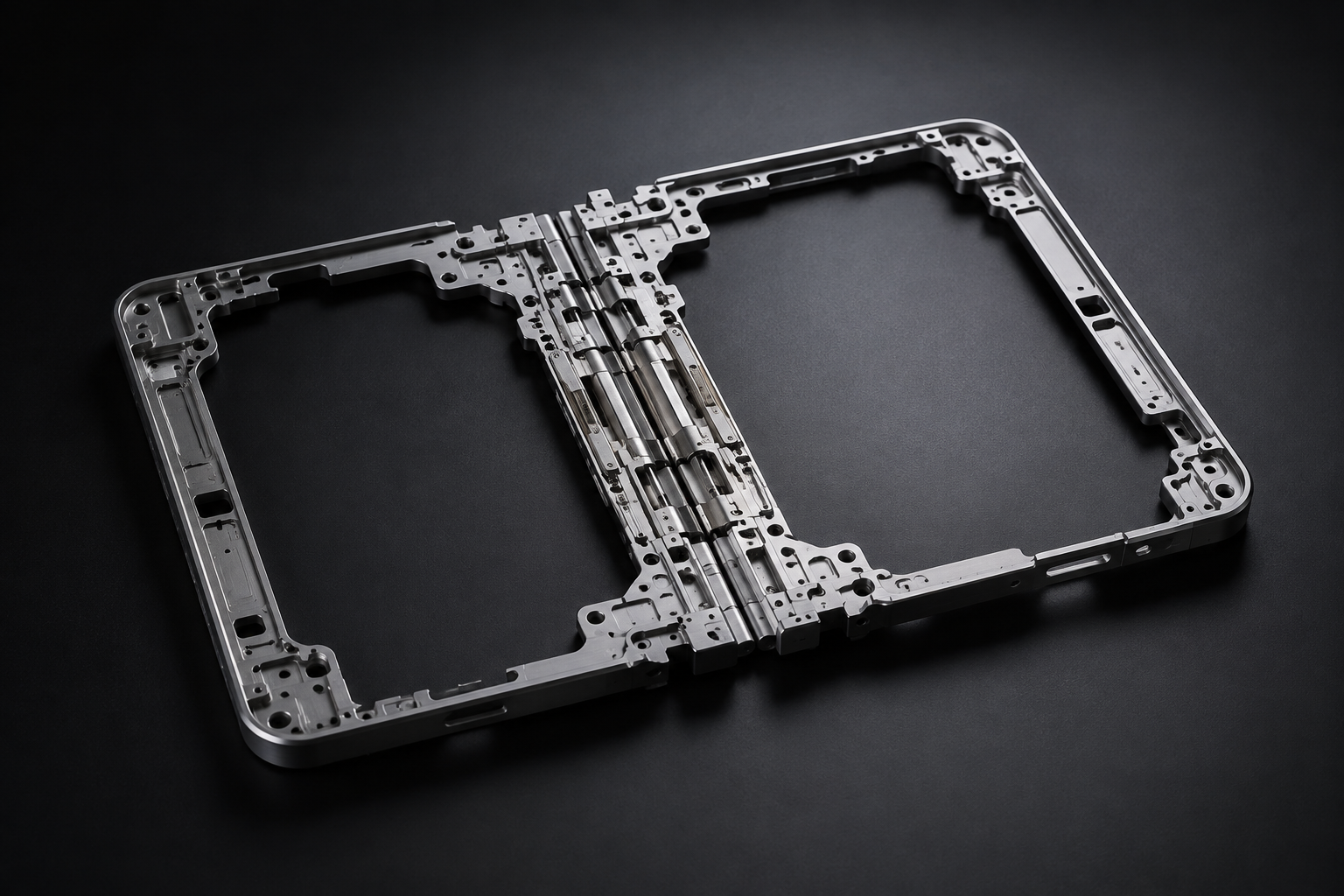
It is produced through CNC machining, one cut at a time.
Titanium is an excellent material: lightweight, strong, and corrosion-resistant.
But anyone who has machined it knows the other side of the story.
Titanium is notoriously difficult to machine.
Its poor thermal conductivity traps heat around the cutting edge.
Its high chemical reactivity increases the risk of tool adhesion.
And its relatively low elastic modulus makes thin-walled parts prone to deflection and dimensional deviations.
Put simply: machining titanium means faster tool wear, a narrower process window, and a cutting edge that can make or break the entire process.
There is another major challenge:
Liquid-metal hinges.
The liquid metal reportedly used for the hinge is a zirconium-based amorphous alloy, formed through die casting or injection molding rather than conventional machining.
According to supply-chain reports, its material strength can reach around 2.5 times that of titanium alloy.⁶
However, reported forming yields have been as low as around 65%, with other reports putting the range at 30%–65%.⁷
The hinge is a problem for materials scientists to solve.
The mid-frame is a problem every cutting tool has to solve.
The more expensive the phone, the thinner the frame, and the larger the production volume, the harder every tool is pushed.
02
The Yield Equation Always Ends Up on the Cost Sheet
The math is brutally simple:
Yield Loss = Scrap Rate × Unit Value × Production Volume
The higher the unit value and the larger the production volume, the more costly every percentage point of lost yield becomes.
The same equation applies to any machining shop.
Your “unit value” might be a batch of impellers, valve bodies, or medical implants instead.
And cutting tools are one of the most dynamic variables in that equation.
Change a tool too early, and you scrap a tool that still has useful life left.
Change it too late, and an entire batch of workpieces may be scrapped.
Every wrong decision about when to change a tool gets amplified through the yield equation.
Foldables are simply putting this reality under the spotlight.
As materials become harder to machine, tolerances become tighter, and production volumes increase, the old approach of changing tools by feel and adjusting parameters based on experience is no longer enough for the next generation of manufacturing.
03
The Ticket to Extreme Competition: Turning Uncertainty into Data
What Knowhy is doing, at its core, is turning the uncertainty at the cutting edge into data that can be tracked, calculated, and reused.
Tool Lifespan Management
How long has each tool actually been cutting?
How much wear has it accumulated?
When should it be replaced?
Let the data make the call.
Knowhy Tool Lifespan Management helps manufacturers make more precise tool-change decisions.
When machining titanium and other difficult-to-cut materials with narrow process windows, this kind of data-driven certainty becomes even more critical.
Smart Tool Box
From tool issue to tool return, Knowhy tracks the entire flow—not only controlling tool circulation, but also turning every tool into a traceable asset.
Process Agent
Upload a drawing and get started.
The Process Agent can interpret drawings, check tolerances, match tools and cutting parameters, and verify inventory and lead times—helping engineers move away from repetitive calculations and spend more time on the decisions that actually require engineering judgment.
A production target of 10 million units⁴ ultimately breaks down into countless tool changes, parameter checks, and machining operations across countless production lines.
The one spectacular minute on a product launch stage is built on millions of moments on the shop floor when nothing goes wrong.
📌 Knowhy Takeaway
The battle for foldables may appear to be fought on the launch stage.
In reality, it is fought on yield.
And the battle for yield may appear to be about materials.
In reality, it comes down to the certainty of every cutting operation.
The harder the material, the more expensive experience becomes.
The larger the production volume, the more valuable data becomes.
That is the real competition at the cutting edge—and the entry ticket for every modern machining operation.
Is Your Shop Floor Also Tackling “Hard-to-Cut” Materials?
If you are machining challenging materials such as titanium alloys or high-temperature alloys, we would be glad to visit your shop floor and explore the challenges with you.
Data Sources & Notes
¹ Huawei Mate XT2 launch scheduled for September 7 at 14:30. Source: Huawei official announcements and public statements by Richard Yu, August 2026.
² Apple’s 2026 fall event is scheduled for 10:00 a.m. Pacific Time on September 9 (1:00 a.m. Beijing time on September 10). Tim Cook is scheduled to step down as CEO on September 1 and become Executive Chairman, with John Ternus succeeding him. Source: Apple Newsroom, April 2026. The foldable iPhone has not been officially announced; the article describes it as potentially appearing at the event.
³ Xiaomi 18 Fold is expected to launch in September 2026. Source: media reports.
⁴ Apple’s first foldable iPhone is reportedly expected to have an annual production target of approximately 10 million units. Source: analyst Ming-Chi Kuo, as reported by Caixin and Yicai, among others. This is an analyst estimate, not an official Apple figure.
⁵ Titanium alloy mid-frames are considered one of the major hardware additions in foldable smartphones. Source: supply-chain sources and industry research.
⁶ The reported liquid-metal material is a zirconium-based amorphous alloy, formed through die casting/injection molding rather than conventional machining. Its reported material strength is approximately 2.5 times that of titanium alloy. Source: supply-chain reports on material characteristics; not an official Apple product specification.
⁷ Reported forming yield for the liquid-metal hinge is approximately 65%, with some reports suggesting a range of 30%–65%. Some reports also cite an internal Apple yield threshold of 85%. Sources include Sina Finance, Tencent Securities, and other media reports citing supply-chain information. These figures are not officially confirmed by Apple.