

 +86 512 6938 3264
Knowhy Insight
Policy Trends × Cutting Management
Last Thursday (July 30), the news release from China’s Central Politburo meeting quickly became a hot topic across the manufacturing industry.
Among the key messages was:
“Develop emerging pillar industries with strong momentum.”
Artificial intelligence, robotics, low-altitude economy, aerospace — these industries are attracting enormous attention.
But for machining companies, there is another perspective:
No matter how “new” these industries are, their core components must first pass through the cutting tools in your workshop.
🔧 The policy highlights the pillars.
But every “brick” supporting those pillars is created through machining.
❓ The Real Question:
When orders from emerging pillar industries arrive,
can your workshop truly handle them?
01 | The Hotter the Industry, the Higher the Cutting Challenge 🚀
Let’s look at the momentum behind these industries:
📈 ≥30%
Growth rate of AI-related manufacturing industries in the first half of the year
📈 +23.1%
Year-on-year growth of integrated circuit production
(Export value increased by 88.7%)
🤖 100,000 units
Expected annual production capacity of humanoid robots
Behind these numbers is a direct upgrade in machining requirements.
The joints, precision screws, and reducers of robots all rely on micron-level machining accuracy.
Carbon fiber structures in the low-altitude economy, battery housings and motor rotors in new energy vehicles — all require stable mass production with consistent quality.
The newer the industry, the stricter the requirements for:
✅ Precision
✅ Consistency
✅ Traceability
✅ Production stability
When a pillar industry grows one meter higher, the skills at the cutting edge must go one step deeper.
There is another change that many companies overlook:
Many customers in emerging industries are “data-native” companies.
During supplier audits, they no longer only check finished samples. They also ask:
❓ How do you manage tool lifespan?
❓ How do you trace machining abnormalities?
❓ Can you provide process data?
The threshold at the cutting edge is not only about precision — half of it is data.
02 | The Policy Has Two Messages — The Second One Is Written for Machining Companies 🏭
Many people focus only on:
“Develop emerging pillar industries.”
But they often overlook another important message:
“Continue upgrading traditional industries.”
The “pillar industries” part is about emerging sectors.
But “upgrade traditional industries” is directly related to machining companies.
Why is transformation being emphasized?
Because recent economic data shows increasing differentiation:
📊 49.2%
Manufacturing PMI in July, down 1.1 percentage points
📊 53.3%
High-tech manufacturing PMI, remaining in expansion territory
The gap is no longer simply between “new” and “old” industries.
It is between companies that can:
✅ Calculate costs accurately
✅ Maintain stable quality
✅ Control production processes
and those that cannot.
Industrial upgrading does not mean chasing every new concept.
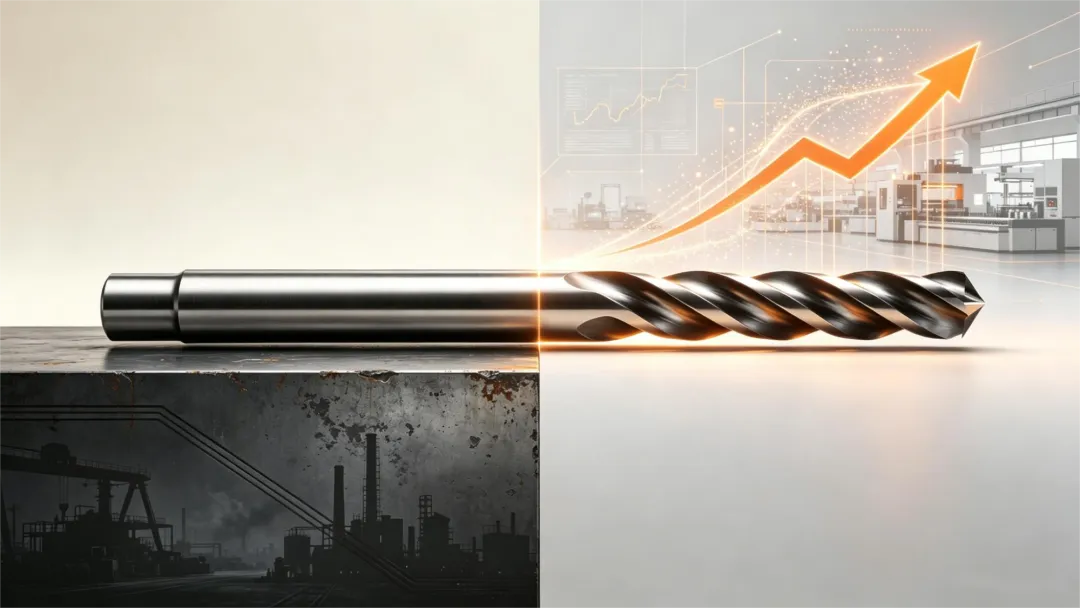
It means making every cutting process in your workshop measurable, controllable, and optimizable.
03 | The Starting Point of Transformation Is Closer Than You Think 🔍
When people talk about “industrial upgrading,” many factory owners immediately think of:
🏗️ New equipment
💻 New systems
📊 Digital dashboards
But one important cost is often overlooked:
💰 3%–5%
Direct tool purchasing cost as a share of production cost
💰 15%–20%
Total cutting-related cost caused by improper tool selection, experience-based tool changes, and idle inventory
This means the starting point of transformation may not be a huge digital project.
It could be:
The tool change happening at 3:00 PM today.
Ask yourself:
🔹 Was this tool truly at the end of its lifespan, or was it replaced too early based on experience?
🔹 Was the cause of the last machine downtime analyzed and recorded, or did it remain only in an operator’s memory?
🔹 Was the removed tool really scrap, or could it still continue working?
Every cutting operation that is:
📌 Recorded
📌 Analyzed
📌 Optimized
brings digital transformation from concept into reality.
This is exactly what Knowhy has been focusing on for years:
Turning the major mission of “traditional industry upgrading” into practical improvements on the shop floor.
🔄 Manage Tool Flow
Ensure every tool issue and return is fully recorded.
🎯 Optimize Tool Changes
Let real tool lifespan data — not intuition — determine when tools should be replaced.
👀 Monitor Equipment Status
Transform machine wear trends into visible and actionable data.
🧠 Build a Data Foundation
Integrate:
200,000+ materials
20,000+ workpieces
10,000+ machining process solutions
into one unified management platform.
Industrial upgrading sounds like a national strategy.
But inside the workshop, it means doing these four things right — every single day.
04 | Before the Next Industry List Is Released 📌
Industry priorities will continue to evolve.
But one thing will never change:
Every emerging industry needs machining suppliers that can truly deliver.
The July data has already shown:
Orders will not be distributed equally.
They will flow to factories that can:
✅ Control costs
✅ Guarantee quality
✅ Provide traceable data
Start building your cutting data assets today.
🌱 No matter how the industry list changes,
you can always stay connected to the supply chain.
🔎 Knowhy Insight
Industry trends tell you where the wind is blowing.
Cutting capability determines whether you can catch that wind.
Industrial upgrading does not need to wait for a major project.
It can start with the next tool change.
Cutting deserves better management.
Let’s talk about the future of machining.