

 +86 512 6938 3264
Knowhy Insight:Everyone Is Talking About Smart Factories. Where Should You Start?
Over the past month, China has sent a series of strong policy signals on advanced manufacturing.
September · Beijing
China held its National Conference on Advanced Manufacturing—the first national-level conference dedicated to the topic. It set the direction for manufacturing to become more intelligent, greener, and more deeply integrated. Jiangsu was one of two provinces invited to share its experience. ①
October · Guangzhou
Guangdong followed with a province-wide conference and specific targets: by 2028, it aims to develop more than 1,000 advanced-level, excellence-level, and leading smart factories, with AI adoption exceeding 50% among manufacturing enterprises above the designated size. ②
The direction is clear. The targets are specific.
But for every individual factory, one question remains:
Where do you start?
01 | Break It Down, and It All Comes Down to the Same Small Things
A smart factory may sound like a massive undertaking. But break it down, layer by layer:
Smart Factory → Workshop → Production Line → Machine Tool → A Single Cutting Tool
At the smallest level, even the most advanced factory deals with the same things: a cutting tool, a tool change, or an unexpected machine issue.
This means large manufacturers and small and medium-sized factories start on equal footing at the smallest operational level.
A cutting tool in a leading smart factory is fundamentally the same as one on your shop floor.
The difference lies in one thing:
How well is it managed?
So the answer to “Where should we start?” is not hidden in an assessment document.
It is right beside the machine tool.
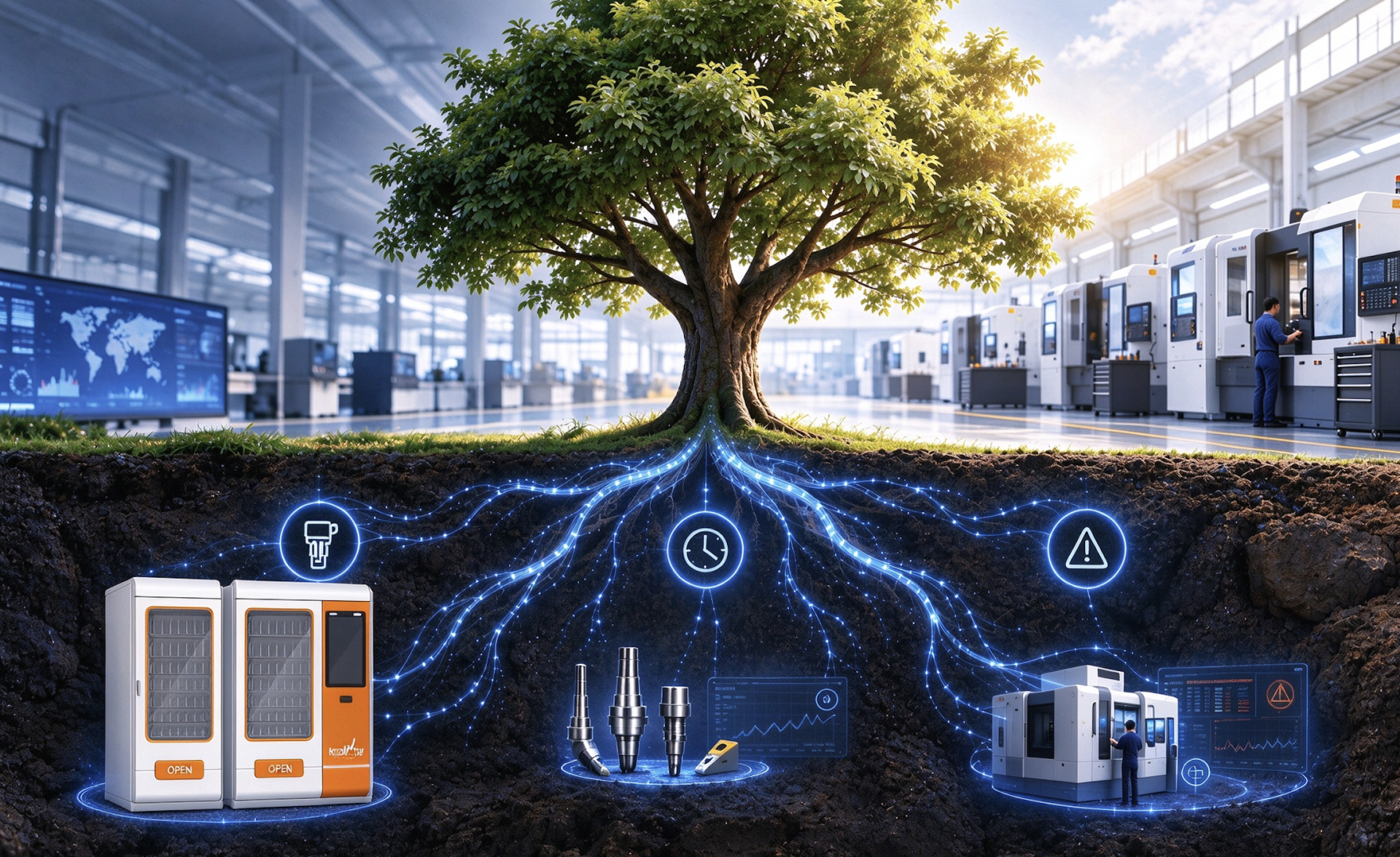
02 | The Height of the Tree Depends on the Density of Its Roots
Smart manufacturing does not begin by building the top floor and adding the foundation later.
The sequence cannot be reversed.
When tool withdrawals are recorded, inventory and tool circulation become data.
When tool changes are based on evidence, production cycles become more stable.
When machine anomalies can be detected early, production plans are less likely to be disrupted by unexpected downtime.
These are the roots of smart manufacturing.
Without digitizing these fundamental actions, even the most advanced systems built on top of them risk standing on shaky ground.
So rather than focusing only on smart factory ratings, ask a more practical question:
How many of the smallest operational units on your shop floor have already been digitized?
03 | Manage the Smallest Units, and the Ratings Will Follow
Knowhy starts at the smallest operational level.
Smart Tool Box keeps every tool withdrawal and return under control.
Tool Lifespan Management helps determine when each tool should be changed.
SCB Smart-CNC-Box makes machine conditions visible, supporting the shift from reactive repairs to predictive maintenance.
Tool Management Operations System brings these activities together and turns them into a data foundation.
Once these smallest units are digitized, the requirements for basic-level and advanced-level smart factory assessments become much more achievable, one item at a time.
Even if smart factory ratings are not an immediate priority, there is one practical action worth taking away from this article:
Make a list of which smallest operational units are already digitized—and which still depend on people to keep things running.
That list may reveal the gaps earlier and more clearly than an assessment checklist.
Knowhy Insight
Policy sets the direction. Day-to-day operations determine what a factory becomes.
Manage every cutting tool, every tool change, and every machine properly, and the intelligence of the entire factory has a solid foundation to grow from.
A smart factory is not created by an assessment. It grows from the digitization of every smallest operational unit.
Knowhy | Full-Stack Cutting Management Solution Provider
Make Every Cut Create Visible Value.
Sources & Notes
① The National Conference on Advanced Manufacturing was held in Beijing on September 16–17, 2026. It was the first national-level conference dedicated to advanced manufacturing and emphasized intelligent, green, and integrated development. Jiangsu and Hubei were the two provinces invited to speak. Source: People’s Daily, front-page report, September 18, 2026.
② Guangdong’s provincial conference on advanced manufacturing was held in Guangzhou on October 9, 2026. Targets included developing more than 1,000 advanced-level, excellence-level, and leading smart factories by 2028, achieving AI adoption above 50% among manufacturing enterprises above the designated size, and producing more than 80,000 humanoid robots. Source: China News Service, October 9, 2026.