

 +86 512 6938 3264

KNOWHY | MANUFACTURING INSIGHTS
The Cost Behind the Drawing
A Drawing Defines More Than the Shape of a Part
AI-powered automatic programming is entering mold-making workshops
R&D lead time reduced by one week
A real-world application of an AI-powered automatic programming agent at a mold manufacturer in Shandong, China. ①
AI-powered automatic programming is moving from concept to real-world manufacturing. At a mold manufacturer in Shandong, the adoption of an AI programming agent shortened the R&D lead time for new orders by one week. ①
But between a drawing and a qualified part, the starting point isn't the CNC program.
Before programming begins, the shop floor already needs to answer a series of questions:
Can the tool reach the bottom of a deep cavity?
What tool diameter is suitable for a small internal radius?
Will tighter tolerances require additional finishing operations or inspection?
The answers are already shaping machine selection, tooling, workholding, and cycle time.
01 | A Drawing Also Defines the Cost of Machining
Changing a dimension in a design file may take only a few seconds. On the shop floor, however, that small revision could require an entirely different machining approach.
Narrow, Deep Cavities and Deep Holes
Longer tools and multiple cutting passes may be required. Chip evacuation and tool rigidity can also become major constraints. ②
Small Internal Radii
The smaller the internal radius, the smaller the tool diameter generally needs to be. This can affect cutting speed and the number of tool passes required. ②
Tighter Tolerances
A tighter tolerance is more than just another number on a drawing. It may require slower machining, additional setups, dedicated inspection tools, or even a different machining strategy. ③
The key question is not simply, "Can we make this part?"
It's: What will it take to make it?
02 | Cost Evaluation Should Happen Before Programming
Material, labor, tooling, and inspection all contribute to the final manufacturing cost. But if the process plan has not yet been properly evaluated, any cost estimate is likely to remain just that—an estimate.
When a drawing reaches the shop floor, three questions are worth asking:
1. Which Feature Determines the Overall Cycle Time?
It may not be the largest or most visually prominent feature. It could be the deepest cavity, the smallest internal radius, or the tightest tolerance.
2. Can Setups and Tool Changes Be Reduced?
If multiple features can be machined from the same direction, or with compatible tools, the overall machining strategy may be simplified. ②
3. How Much of the Work Can Be Covered by Existing Tools?
If special tooling is required, procurement, lead times, and tool preparation need to be considered early—not after the program has already been generated.
These three questions turn a drawing from a design output into a production input.
They also move cost management upstream—from post-production cost analysis to the stage where the machining strategy is being developed.

03 | Knowhy Process Agent
Turning Drawings into Executable Process Plans
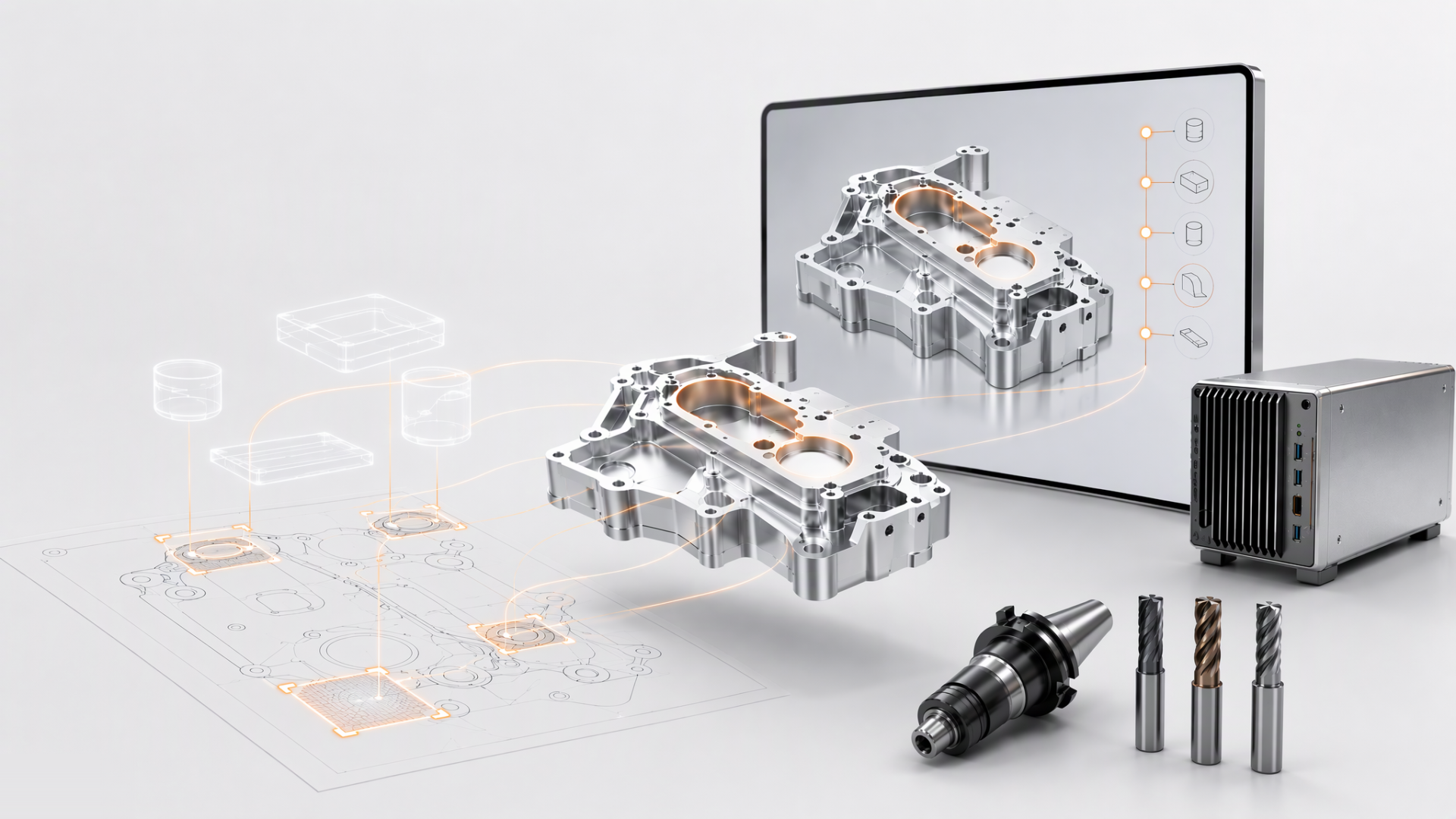
The starting point for Knowhy Process Agent is not simply generating a CNC program. It is understanding the drawing and systematically identifying the constraints that will affect machining.
STEP 1 | Upload the Drawing
Upload 2D and 3D drawings. AI analyzes the part features and geometric elements.
STEP 2 | Review and Confirm the Drawing
Engineers review and verify the identified features through linked 2D drawings and 3D models. Any areas the AI cannot confidently identify are flagged for human confirmation.
STEP 3 | Process Planning
Based on the factory's actual machine capabilities and available workpiece stock, the system breaks down the manufacturing process into operations and steps, specifying the machine, tools, and cutting parameters required for each operation.
STEP 4 | Intelligent Tool Selection
Once connected to the tool inventory through an interface or by importing inventory data, the system automatically checks available tools and generates a process plan together with a pre-production tool preparation list.
The result is a structured, reviewable plan covering:
Drawing interpretation
Operations and machining steps
Machine and tool assignments
Cutting parameters
Tool availability and preparation
This gives engineers and production teams a clearer basis for evaluating the process before machining begins.
One More Question Before Programming
The next time you review a part drawing, consider asking:
What will this feature add to the machining process?
KNOWHY TAKEAWAY
A drawing determines more than what a part looks like. It also influences how the part will be made on the shop floor.
Understand machining constraints before programming begins,
and cost management no longer has to wait until after production.
REFERENCES
① Xinhua News Agency | November 6, 2026
China Accelerates the Comprehensive Application of Artificial Intelligence Across Industries
② Protolabs | August 27, 2026
What Is G Code? CNC Programming and How It Works
③ Xometry | July 20, 2026
What Every Designer Needs to Know About CNC Part Tolerances