

 +86 512 6938 3264
If a general large language model is simply a brain that answers questions, an Agent is something different:
a system that can perceive its environment, call external systems, and complete an entire workflow autonomously.
It doesn’t just give advice—it gets the job done.
That’s why more and more machining companies are starting to ask a practical question:
Can we build a Process Agent that actually works on the shop floor?
In a machining workshop, no one cares about concepts.
There is no “AI hype” here—there is only cycle time.
The moment a drawing arrives, the clock starts ticking.
Feature breakdown, tool matching, parameter derivation, inventory verification, list preparation—these tasks may not seem complex, but they are extremely specific, and the margin for error is close to zero.
A wrong tool model means machine downtime.
A wrong parameter can mean tool breakage.
So when we talk about a Process Agent, the question must be very practical:
Can it actually complete a full process decision workflow for the engineer?
If not, it’s just another query tool.
Engineers Don’t Need Suggestions. They Need Results.
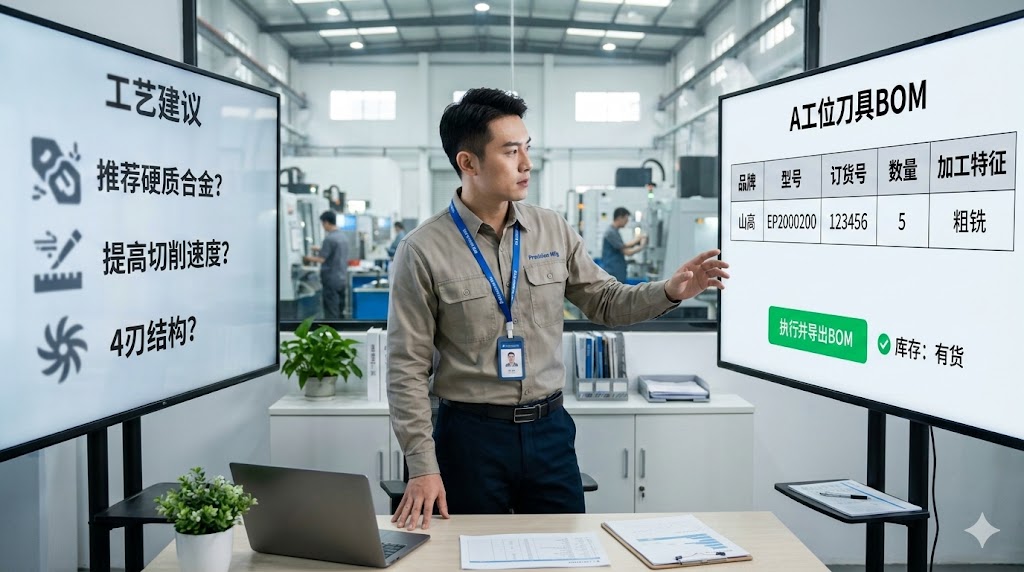
AI is very good at making suggestions:
Use carbide tools
Consider a 4-flute design
Increase cutting speed
These statements may be technically correct—but on the shop floor, they are not particularly useful.
What engineers really need is an executable result:
A specific brand
An exact model number
A complete ordering code
Required quantities
A clear match between tools and machining features
Ideally, the system should also export a tool BOM with one click, ready to enter the procurement process.
The value of process engineering is not in expressing ideas—it lies in producing decisions that can be ordered, installed, and executed.
If engineers still need to check catalogs, verify inventory in another system, and manually organize lists, then the Agent has merely changed the entry point of information, not reduced the workload.
The Real Challenge Is Real-World Constraints
Calculating a theoretical optimum is not difficult.
The real challenge is finding the best solution under real constraints.
A certain tool may be perfect from a machining perspective—but inventory is zero.
A substitute exists in the warehouse—but delivery risk is high.
A supplier has stock—but the price exceeds the budget.
Process engineers deal with multi-constraint decision-making every day, not ideal theoretical scenarios.
A truly valuable Process Agent must therefore go beyond understanding materials, features, and cutting parameters.
It must also read and integrate:
Enterprise inventory data
Purchase orders in transit
Supplier delivery times
Compatibility of substitute models
Only then can it generate the most executable tool list under current conditions.
Otherwise, it is solving a theoretical problem, not participating in real production.
Process planning has never been just a laboratory problem.
It is also a supply chain problem, a cost problem, and a delivery problem.
Tools and Parameters Must Be Tightly Coupled
Many systems treat tool selection and parameter recommendation separately.
But on the shop floor, these two are strongly coupled.
Conservative parameters reduce productivity.
Aggressive parameters increase the risk of tool breakage.
Recommending tools without parameters—or parameters without specific tool models—means the result remains theoretical.
If an Agent participates in tooling decisions, it must take responsibility for the full outcome:
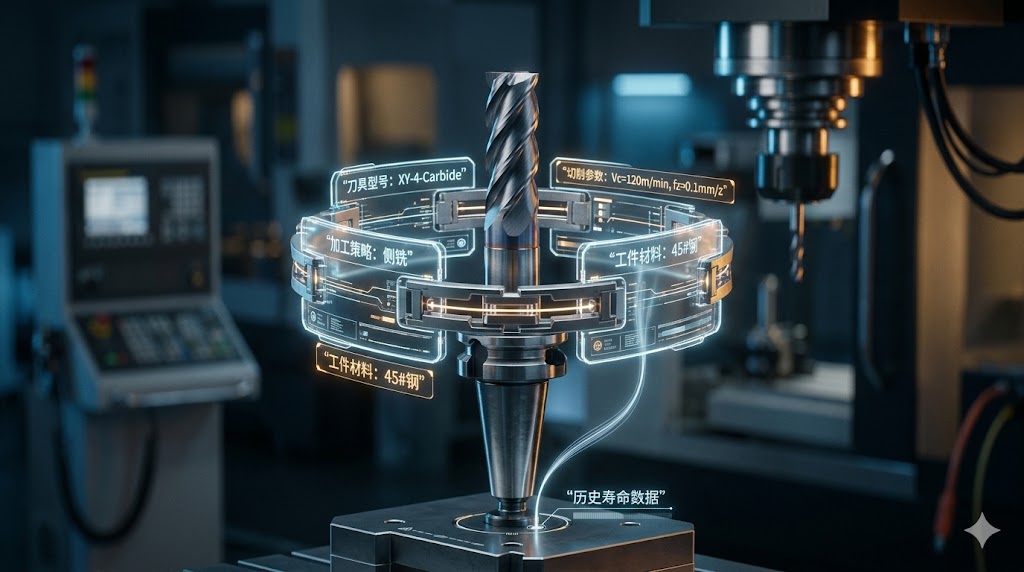
Parameters must be linked to specific tool models
Linked to materials and machining strategies
Supported by historical tool lifespan data
Only then will the generated list be not only technically feasible, but production-ready.
If It Can’t Enter Procurement, the Decision Isn’t Finished
There is a simple way to judge whether a Process Agent is mature:
Can it export a structured tool BOM?
Can it integrate with ERP systems?
Can it generate procurement instructions?
Can it create a data feedback loop?
If engineers still need to reorganize the data manually, the system remains an assistant tool.
A true industrial-grade Agent must be embedded into business workflows, not confined to a chat interface.
When Engineers Shift from “Calculators” to “Decision Makers”
Many people ask whether AI will replace process engineers.
In daily use of general AI, we already see a pattern emerging:
we no longer write everything from scratch. Instead, AI generates a draft first.
Our role shifts to reviewing and judging—checking logic, correcting mistakes, and deciding whether the output is truly usable.
Industrial AI will follow the same path.
When a Process Agent becomes mature enough, engineers will no longer spend hours searching catalogs, calculating combinations, or verifying inventory and delivery schedules.
These structured, repetitive tasks are better handled by AI systems.
The role of engineers will naturally evolve:
From calculators → decision makers
From repetitive execution → risk control
But this shift depends on one critical condition:
the Agent must produce near-executable results.
If it only provides vague suggestions and engineers still have to redo the entire process, then this so-called role upgrade never truly happens.
Real process intelligence does not replace humans.
It elevates them—allowing engineers to focus on:
judging whether decisions are robust
controlling operational risks
optimizing overall system efficiency
When AI takes over most structured calculations, engineers can finally free their minds from repetitive derivations.
Only then will AI truly enter the core of machining operations.
Otherwise, it remains nothing more than a smarter search box.